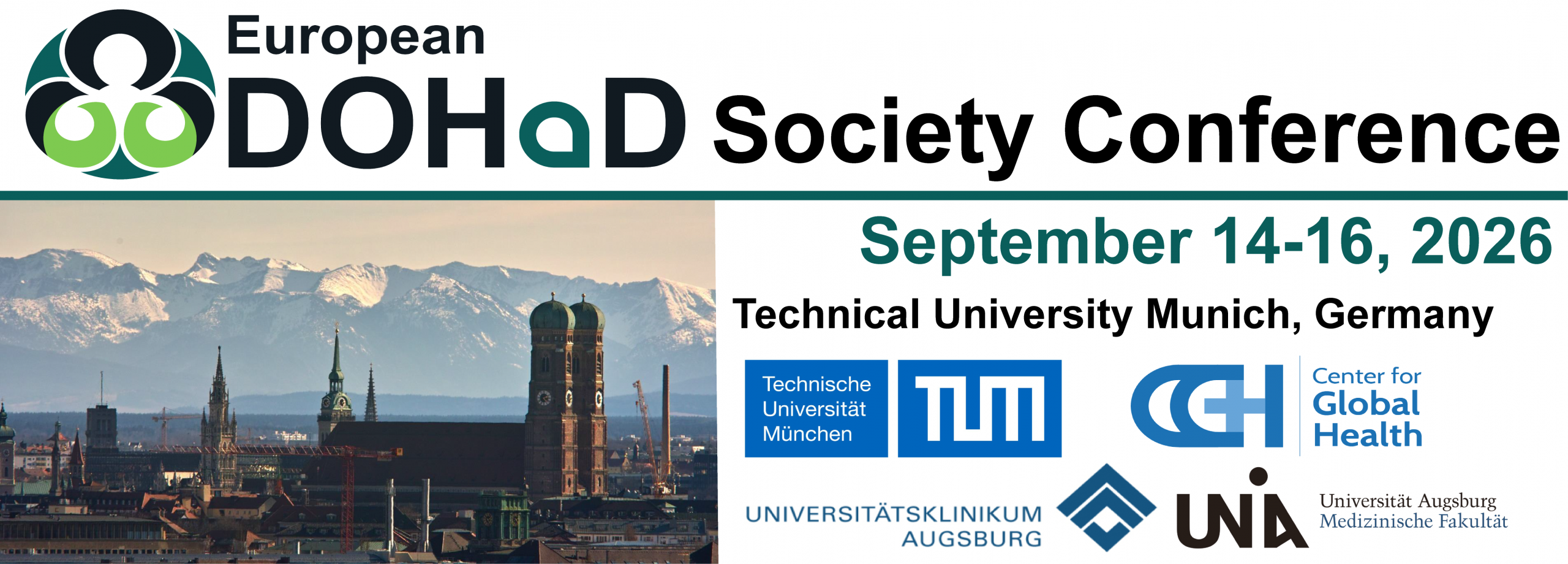
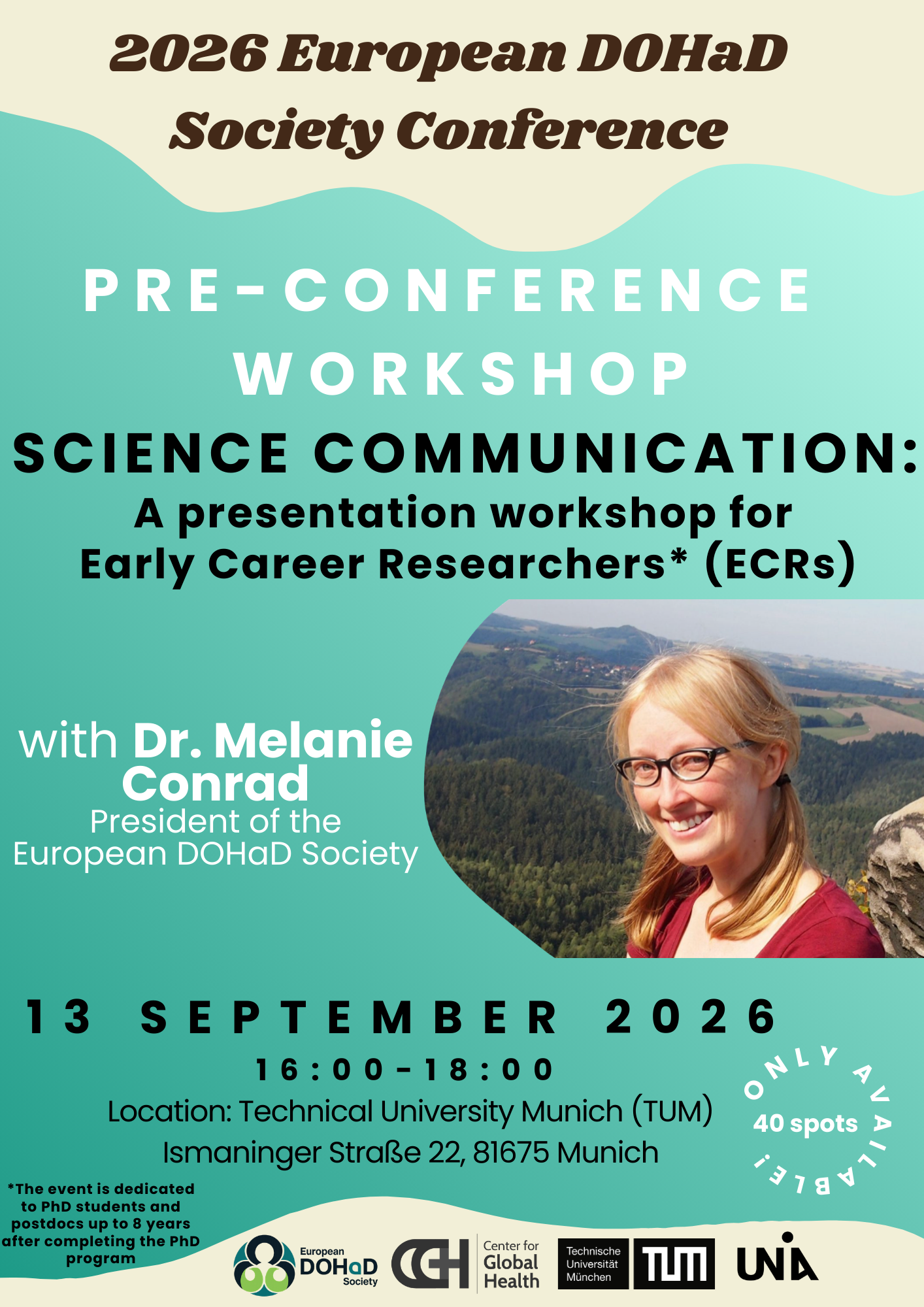
2026 – European DOHaD Conference

WELCOME

As President of the European DOHaD Society, it is my great pleasure to welcome you to our upcoming conference in Munich this September.

The Developmental Origins of Health and Disease framework continues to transform how we understand the lifelong impact of early-life environments on health and wellbeing.
Across Europe and beyond, our community is generating innovative insights spanning molecular mechanisms, clinical research, population science, and policy translation. This meeting will provide a vibrant platform to share new discoveries, foster interdisciplinary dialogue, and strengthen collaborations that advance prevention across the life course.

Munich offers an inspiring setting for scientific exchange, where tradition meets innovation at the heart of Europe. I warmly invite researchers, clinicians, public health professionals, policymakers, and early-career scientists to join us for what promises to be an engaging and forward-looking conference.
I look forward to welcoming you personally and to the stimulating discussions that will shape the future of DOHaD research and its impact on global health.

Melanie Conrad, PhD
President of the European DOHaD Society

PROGRAM

The full program will be announced soon!

Confirmed Speakers

Prof. Keith Godfrey

Prof. Christine Heim

Prof. Tim Nawrot

Dr. Michael Penkler
Prof. Fatimi Crispi

Prof. Petter Brodin

Prof. Tomoki Arichi

Prof. Luca Chiapperino
 

Name

Country

Session

Country

Prof. Keith Godfrey

United Kingdom

Keynote lecture 

United Kingdom

Prof. Christine Heim

Germany

Adverse childhood experiences, neurodevelopment and life course health

Germany

Prof. Tim Nawrot

Belgium

Environmental pollutants, toxins, and climate change: Impact on disease susceptibility.

Belgium

Dr. Michael Penkler

Austria

Social, cultural and political aspects: Implications for DOHaD research

Austria


Sex and gender differences in early life and adolescence.


Prof. Fatimi Crispi

Spain

Pregnancy disorders and placentation in the context of maternal and offspring health. 

Spain

Prof. Petter Brodin

Sweden

Evidence from the life sciences: What can we learn about DOHaD mechanisms?

Sweden

Prof. Tomoki Arichi

United Kingdom

Modifiable factors and interventions for improving long term health.


Prof. Luca Chiapperino

Switzerland

The relationship between DOHaD, public health and health policy.

Switzerland


Sessions:

  • Session 1 – Adverse childhood experiences, neurodevelopment and life course health.
  • Session 2 – Environmental pollutants, toxins, and climate change: Impact on disease susceptibility.
  • Session 3 – Social, cultural and political aspects: Implications for DOHaD research.
  • Session 4 – Sex and gender differences in early life and adolescence.
  • Session 5 – Pregnancy disorders and placentation in the context of maternal and offspring health.
  • Session 6 – Evidence from the life sciences: What can we learn about DOHaD mechanisms?
  • Session 7 – Modifiable factors and interventions for improving long term health.
  • Session 8 – The relationship between DOHaD, public health and health policy.

Extra-activities:

ABSTRACTS

Abstract submission is open for the 1st European DOHaD Conference, 14-16 September 2026, in Munich (Germany).
We invite participants to submit abstracts for talks and posters.

Key dates:

31 May 2026: Abstract submission deadline

31 May 2026: ECR* travel award application deadline

15 July 2026: Abstract decision announcement

15 July 2026: Travel award decision announcement

31 May 2026: Early-bird registration deadline; all presenters must be registered and paid

21 August 2026: Final registration deadline

*ECR are students and researchers up to 7 years after completing a PhD program.

Important:

• All abstracts are required to be submitted through the online submission system.

• The abstract text must not exceed 300 words and include background, aims, methods, results, and conclusions. Tables or figures are not permitted.

REGISTRATION

The registration fee covers access to the conference venue and the full scientific program, the welcome reception, catering during coffee breaks, and daily lunches.

Hotel accommodation is not included and must be arranged independently. During registration, participants may also book optional activities, including the conference dinner, workshops or Early Career Researchers* events. For more information on optional activities, please see this LINK.

Abstract submission is handled separately from conference registration. For details on abstract submission, please see this LINK. 

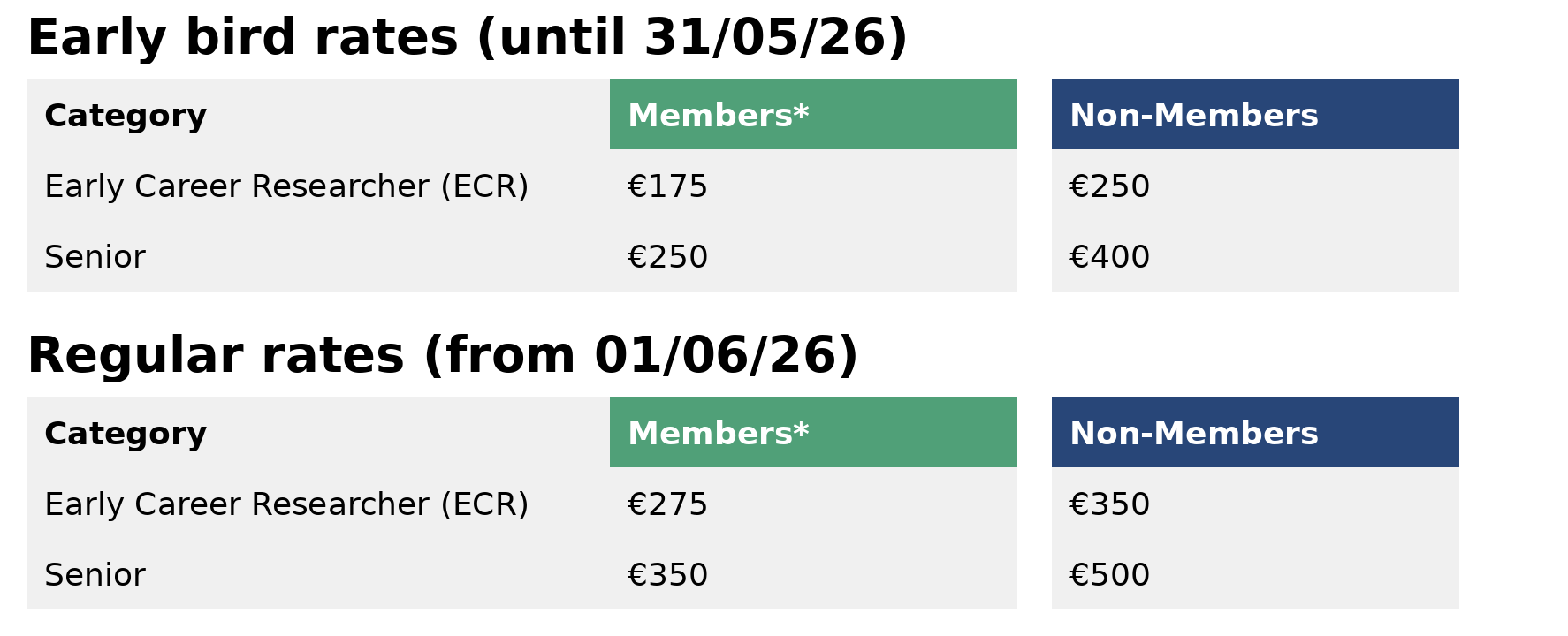
Early Bird (until May 31, 2026)Regular (from June 1, 2026)
 European and French DOHaD Society MembersNon-Members European and French DOHaD Society MembersNon-Members
Early career researcher (ECR)*175 EUR250 EUREarly career researcher (ECR)*275 EUR350 EUR
Senior250 EUR400 EURSenior350 EUR500 EUR

*ECR are students and researchers up to 7 years after completing a PhD program 

ORGANIZING COMMITTEE

Clarissa Prazeres da Costa

Clarissa Prazeres da Costa

Fabian B. Fahlbusch

Fabian B. Fahlbusch

Melanie Conrad

Melanie Conrad

Marlou de Kroon

Amanda-Sferruzzi Perri

Amanda-Sferruzzi Perri

Julie Nihouarn-Sigurdardottir

Julie Nihouarn-Sigurdardottir

Hani Harb

Hani Harb

Jorge Lopez-Tello

Magdalena Klimek

LOCATION

Location

Travel to Munich: Munich is easily accessible from all major international and European destinations. Munich International Airport (MUC) offers numerous direct flights worldwide and is efficiently connected to the city center by suburban train (S-Bahn), with a travel time of approximately 40 minutes.

For those traveling by rail, Munich Central Station (Hauptbahnhof) provides high-speed and direct connections to cities across Germany and Europe. Munich is also well connected by an extensive motorway network, ensuring convenient access by car.

AccommodationSince Octoberfest starts on September 19th, we suggest that you book your accommodation early!

  • VENUE

    Technical University of Munich, Ismaninger Straße 22, 81675 Munich (Germany)

  • TRAVEL TO MUNICH

    Munich is easily accessible from all major international and European destinations.
    Munich International Airport (MUC) offers numerous direct flights worldwide and is
    efficiently connected to the city center by suburban train (S-Bahn), with a travel time
    of approximately 40 minutes.
    For those traveling by rail, Munich Central Station (Hauptbahnhof) provides high-
    speed and direct connections to cities across Germany and Europe. Munich is also
    well connected by an extensive motorway network, ensuring convenient access by
    car.

  • ACCOMMODATION

    Since Octoberfest starts on September 19th, we suggest that you book your
    accommodation early!

Recommended Hotels in Munich

  • Hotel Adria München
    Address: Liebigstrasse 8a, 80538 München
    Email: reception@adria-muenchen.de
    Phone: +49 892421170
    Website: https://adria-muenchen.de/en/
  • Novotel München City

    Address: Hochstrasse 11, 81669 München
    Email: H3280@accor.com
    Phone: +49 89661070

Website: https://www.novotel-munich.com/

  • mk hotel münchen max-weber-platz

    Address: Einsteinstraße 34, 81675 München
    Phone: 8723978712200
  • Hotel München Palace

    Address: Trogerstraße 21, 81675 München
    Phone: 89419710

CONTACT

Regional European Developmental Origins of Health and Disease Society e.V.
Universitätsklinikum Augsburg Neonatology and Pediatric Intensive Care Medicine Section Translational Neonatology
Working Group Stenglinstr. 2 86156 Augsburg, Deutschland
Questions may be directed to: eds.info@dohadsoc.org
Follow us on social media for the latest info!